Removing a tree is not always as simple as cutting it down and hauling away the debris. Large trees, restricted access, nearby structures, and unstable tree conditions can make a standard removal much more complicated.
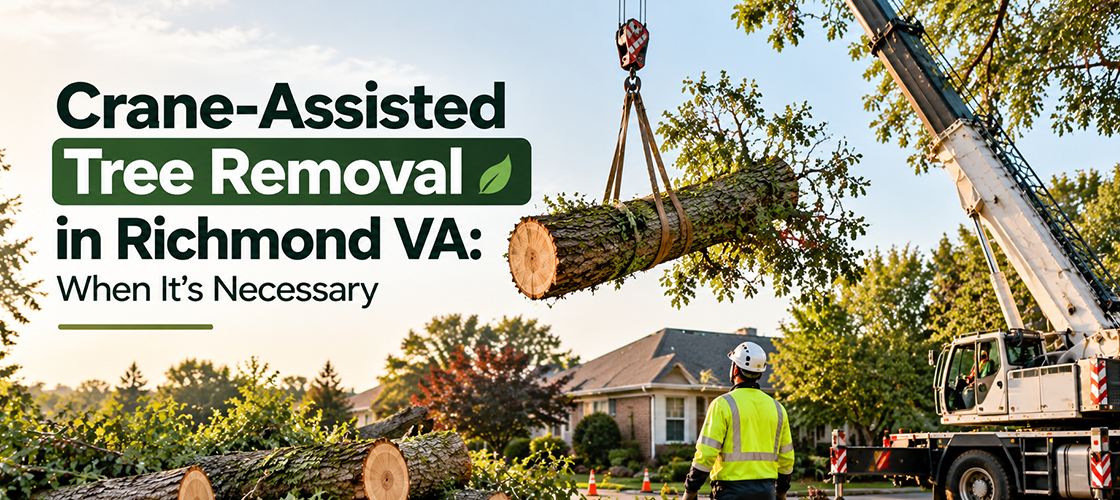
In these situations, crane tree removal Richmond VA services can provide a controlled way to dismantle and remove large sections of a tree. A crane is not necessary for every removal, but it can be useful when traditional climbing and rigging methods are not the safest or most practical option.
Understanding when crane-assisted removal is appropriate can help property owners make informed decisions about a large or difficult tree on their property.
A crane is typically considered when the size, condition, location, or surroundings of a tree create challenges for conventional removal methods.
Very tall trees with heavy trunks and large branches can require extensive climbing and rigging when removed section by section. Depending on the tree’s size and location, a crane can help lift large pieces directly from the tree and place them in a controlled area.
This can make certain large tree removal Richmond VA projects more manageable, particularly when there is limited room for ground-level handling.
A tree may be located close to a house, garage, fence, driveway, pool, or another structure. In some properties, there simply isn’t enough open space to safely lower large branches using conventional ropes.
Crane-assisted removal allows sections to be lifted away from the tree instead of being lowered through a crowded area. This can be especially useful for tree removal tight spaces Richmond property owners may encounter in developed residential areas.
A severely damaged, decayed, leaning, or storm-affected tree can create additional challenges for a climbing crew. If the tree cannot safely support a climber, alternative removal methods may need to be considered.
Depending on the site conditions, a crane can allow sections to be secured and removed while reducing the amount of climbing required.
For trees affected by severe weather, property owners may also need specialized storm damage tree removal Richmond VA to address immediate hazards.
Trees growing between buildings, over driveways, or close to landscaping may require careful sectional removal. Dropping large pieces is generally not an option when surrounding property needs to be protected.
A crane can provide greater control over where heavy sections are lifted and placed, making it a practical consideration for particularly challenging removals.
Crane-assisted removal requires more planning than simply bringing a crane to the property. The equipment, tree, surrounding structures, access points, and work area all need to be evaluated before removal begins.
The first step is a detailed site assessment. The crew needs to evaluate the tree’s size and condition along with nearby buildings, utility lines, driveways, landscaping, and available access.
The location where the crane will be positioned is also important. Ground conditions, clearance, and space for stabilizing equipment must all be considered.
Cranes require adequate space and stable ground. The crew determines where the equipment can be positioned while maintaining a safe working area.
Overhead obstacles, including utility lines and nearby branches, also need to be considered before the crane is brought into position.
Instead of allowing large sections to fall freely, selected portions of the tree are secured to the crane using appropriate rigging equipment.
The crane operator and tree removal crew then coordinate the lift so that each section can be moved in a controlled manner.
The tree is generally dismantled from the upper sections downward. As pieces are cut and lifted, the crane moves them to a designated landing area.
This approach can reduce the need to lower extremely heavy sections through areas where they could damage structures or landscaping.
Once sections reach the ground, the ground crew processes the wood and manages debris. Depending on the project, this may include cutting larger sections into manageable pieces, loading debris, and cleaning the work area.
If the tree has already been removed and a remaining stump is creating an obstacle, stump grinding can be considered as a separate part of the property cleanup.
No. A large tree does not automatically require a crane.
Experienced tree removal crews can safely handle many large trees using climbing, ropes, rigging, and other conventional techniques. Crane use is generally considered when the tree’s size, condition, location, or surrounding obstacles make those methods less practical.
Using a crane when it is unnecessary can increase the overall project cost. On the other hand, avoiding a crane when the site genuinely requires one can create additional safety and logistical challenges.
The right approach depends on the individual property rather than the tree’s size alone.
Access is one of the most important factors when planning crane-assisted tree removal.
Before scheduling the work, a professional crew needs to determine:
A property may have a large tree but still lack sufficient access for a crane. In those cases, other removal methods may be more appropriate.
One of the main reasons cranes are considered for difficult tree removals is controlled movement.
When a tree is located near a structure, simply allowing branches or trunk sections to fall may not be practical. A crane can lift secured sections and move them toward a designated landing area.
However, crane equipment does not eliminate every property risk. The crane itself is heavy, and improper setup can affect driveways, lawns, or other surfaces. Ground conditions and equipment placement should therefore be evaluated before work begins.
Crane-assisted removal generally costs more than a standard tree removal because the project may involve specialized equipment, a crane operator, additional crew members, rigging, transportation, and more extensive setup.
However, price should be considered in relation to the complexity of the job. A crane may reduce the amount of time required for certain large or difficult removals and provide a controlled method for handling heavy sections.
The final cost can vary based on:
A site assessment provides a more accurate understanding of which removal method is appropriate and what the project may involve.
Many residential tree removals can be completed without a crane. If there is sufficient working space, the tree is structurally suitable for climbing, and branches can be safely lowered using conventional rigging, a crane may not provide enough additional value to justify the cost.
Professional tree removal methods can be selected based on the specific conditions of the property.
Similarly, if only branches need to be removed while the tree itself can remain standing, tree cutting and trimming may be a more suitable solution.
The goal is not to use the most equipment possible. It is to select a removal method that matches the tree and property conditions.
Crane-assisted tree removal involves more than lifting a tree with heavy equipment. The crew must account for tree structure, rigging points, crane capacity, access, ground conditions, nearby structures, utility lines, and the intended landing area for each section.
A professional assessment helps determine whether a crane is actually necessary and how the removal can be organized before work begins.
For property owners dealing with a particularly large, unstable, or restricted tree, this assessment can also help identify potential hazards that may not be obvious from the ground.
Crane-assisted removal can be a practical option when a tree is extremely large, structurally compromised, surrounded by buildings, or positioned where conventional rigging provides limited room to work.
However, not every large tree needs a crane. The appropriate method depends on the tree’s condition, location, access, surrounding property, and available work area.
For crane tree removal Richmond, VA projects, DCS Tree Service evaluates the individual site and determines whether crane assistance is appropriate or whether standard removal methods can safely handle the job.
Call 804-334-8948 to schedule a site evaluation.
Generally, yes. Crane removal involves specialised equipment, an operator, setup, and additional planning. However, it can make certain large or difficult removals more efficient.
Cranes are heavy and require stable ground for their outriggers. Before work begins, the crew should assess the setup area and use appropriate protective measures where needed to help minimise potential surface damage.
The decision depends on the tree’s size and condition, available access, surrounding structures, overhead obstacles, and the amount of space available for safely lowering tree sections. A professional site assessment can determine whether a crane is appropriate.
In some situations, crane-assisted removal can significantly reduce or eliminate the need for a climber to ascend certain portions of the tree. The exact method depends on the tree’s structure, condition, and site layout.
Yes. A crane can be considered when a tree is positioned close to buildings, fences, driveways, or other obstacles and there is not enough room to safely drop or lower large sections using conventional methods.