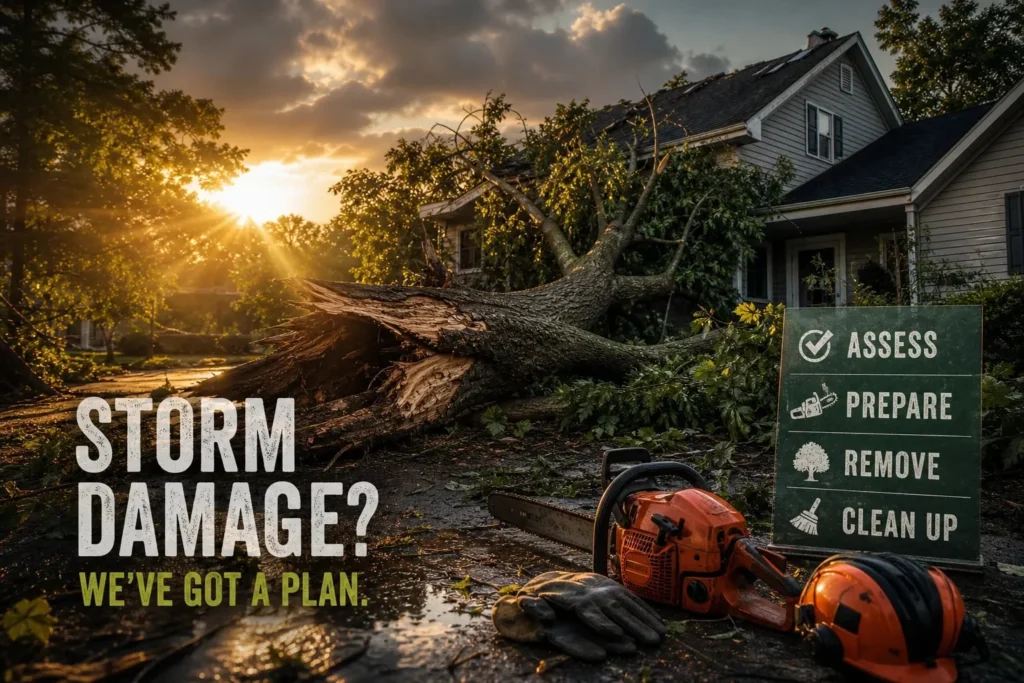
The storm rolled through overnight. By morning the neighborhood was quiet again, but one look out the back window tells the whole story: a split trunk leaning against your fence, a thick limb draped across the roof edge, or a full tree lying where the kids were playing two days ago. The relief that the storm is over collides immediately with that familiar knot in the stomach, what do I do now?
Many homeowners make their situation worse in the first hour after a storm, not because they’re careless, but because they move too fast. After years of responding to storm calls across Richmond and the surrounding counties, our crew at DCS Tree Services sees the same avoidable mistakes repeated: people walking under hanging limbs to get a better look, starting cleanup before documenting anything for insurance, or calling the first number they find online without confirming the company carries proper insurance and meets Virginia’s contractor requirements. Every one of those mistakes can cost time, money, or worse.
This guide walks you through five clear steps for storm damaged tree removal: making the scene safe, assessing whether your tree can be saved, documenting the damage for your insurer, deciding when to call a professional, and understanding what the whole thing will likely cost. Work through them in order and you will move from chaos to a clear plan of action.
The first rule after a storm is simple: no one approaches the damaged tree until the area has been assessed from a safe distance. That means children, pets, and any neighbors who have wandered over to look. Broken or partially attached limbs, sometimes called widow makers by arborists, can drop without any warning even hours after the storm has passed. The tension in storm-split wood is unpredictable, and what looks stable from across the yard can shift the moment conditions change.
Identify the debris fall zone by looking at the full length of the damaged tree or limb and adding a safety buffer in every direction. If you have caution tape, use it. If not, position a lawn chair or trash bin at the perimeter to signal that the area is off limits until a professional clears it.
Treat every wire in contact with a tree as live, no matter what it looks like. A line that appears dead can still carry a lethal charge. The safe distance from any downed or contacted line is at least 35 feet, and that distance applies to wet ground around the contact point as well. Electricity travels through moisture, and walking across a wet lawn toward a downed line is genuinely dangerous.
The call sequence here is 911 first, then your utility company. Do not attempt to move the tree, lift the wire, or even drag a branch away from the contact point yourself. This is not a job for a homeowner, and it is not a job for a tree crew until the utility company has confirmed the lines are de-energized.
If a limb or trunk section has made contact with the house, do a quick assessment from the ground before entering: look for visible roof penetration, any signs of a compromised wall, and smell for gas. If you detect a gas odor, leave immediately and call your gas provider from the street. When there is any doubt about whether the structure is safe to occupy, step out and let a professional make that determination. Insurers generally accept cautious actions taken to prevent further harm, keep a record of steps you took and consult your agent if you are unsure. No property is worth staying inside a compromised building.
Once the scene is secure, conduct a visual assessment from a safe distance. Start at the base of the tree. Visible root plate uplift, soil heaving or cracking radiating outward from the trunk, and a new lean that was not there before the storm are all strong indicators of root system failure. A tree showing those signs very likely needs removal, the root system is what keeps the tree anchored, and once it fails structurally, no amount of pruning changes the outcome. That said, get a certified arborist on site before any final decision is made.
If the roots look stable, shift your attention to the trunk. A vertical split or crack running down the main trunk, significant bark loss on a major load-bearing section, or a fracture at a major crotch point all point toward removal. Bark intact, no deep cracking, and a straight plumb line suggest the tree has structural integrity worth preserving.
The standard benchmark in arborist assessments is the 25/50 rule. Trees that have lost less than 25% of their crown often recover well with proper pruning. The 25, 50% range is a judgment call that depends on the species, the age of the tree, and the overall health of the trunk. Crown loss over 50% means the tree can no longer generate enough leaf surface to sustain itself, and removal is generally the right call. This is not about appearance, it is about the tree’s ability to photosynthesize and fight off decay and disease going forward.
Use this simplified framework as a starting point before a certified arborist arrives for an on-site hazardous tree removal assessment:
This framework gives you a working hypothesis, but any tree with trunk or root damage needs a professional on-site inspection before any final decision is made.
Do not start cleanup until your photo and video documentation is complete. Walk the full scene and capture wide establishing shots that show the tree’s position relative to your home and property lines, close-ups of every impact point, the condition of the root zone, and any structural damage to the house or outbuildings. Use your phone’s native camera so each photo is automatically timestamped, that timestamp can matter when a claim is reviewed weeks later. Keep your original files unedited, since insurers may ask for corroborating evidence such as local weather reports or witness statements alongside your photos.
The most common misconception homeowners have is that any storm-felled tree on their property is automatically covered for tree storm damage insurance purposes. It is not. Coverage under a standard policy generally applies when a tree downed by a covered peril, wind, lightning, or ice, has damaged an insured structure: your home, garage, fence, or an access point required for accessibility. A tree that fell in the open yard without hitting anything covered is typically an out-of-pocket expense. Most policies also cap debris removal at $500 to $1,000, so knowing your actual limit before filing sets realistic expectations from the start.
Gather these items before cleanup starts: timestamped photos and video, local weather event reports confirming the storm date and severity, a written itemized estimate from a licensed tree service, receipts for any emergency tarping or temporary repairs, and your policy’s declarations page. Your insurer will move faster when you hand them a complete file. A written estimate from a properly insured crew is not optional, it is the anchor document for what the cleanup actually cost.
Some storm tree work is genuinely manahire geable as a DIY task: dragging small fallen branches to the curb, clearing debris from a garden bed, cutting up limbs already on the ground that are under three inches in diameter. Beyond that, an arborist after storm-damaged tree removal rather than pushing your luck. Overhead cutting, anything within range of a power line, limbs larger than three to four inches in diameter, trees leaning against a structure, and split trunks with tension in the wood all call for the training, equipment, and rigging experience a certified arborist brings to the site.
The three-cut method professionals use on large limbs exists for a specific reason: an improperly cut limb under tension snaps and kicks back with enough force to cause serious injury. The weight distribution in a storm-damaged tree is not the same as a healthy standing tree, and that unpredictability is what makes storm work more technical, not just more difficult.
When vetting companies for emergency tree removal, the non-negotiables are straightforward. In Virginia, tree service work over $1,000 typically requires a contractor license, and any reputable crew should carry general liability insurance and workers’ compensation coverage, ask for proof of both before signing anything. ISA certification is a strong professional credential worth asking about as well. The company should also provide a written on-site estimate before work begins and be transparent about what fallen tree cleanup and debris hauling are included. Be cautious of crews that show up unsolicited after a major weather event. Storm chasers are a real problem in the Richmond area after significant weather, and they operate on inflated pricing with no local accountability. If a company cannot give you a written estimate and you have never heard of them, that is a signal worth heeding.
That difference shows up in practice. At DCS Tree Services, when you call after a storm, you are talking to the same people who will be on your property doing the work. There is no call center, no subcontractor chain, and no ambiguity around what cleanup is included, we are happy to put it all in writing. We show up, assess the situation honestly, give you a written estimate at no obligation, and handle everything from hanging limb removal to full debris hauling. That direct accountability matters especially after a storm, when you need a crew you can trust to make good decisions on your property.
Storm damage tree removal costs vary considerably based on tree size and site conditions. Here is a general range to help you plan:
For a medium-sized residential job with decent access, most homeowners can expect half a day of work or less from an experienced crew.
Storm-damaged trees are structurally unpredictable. Tension and compression in split wood behave differently than a standing healthy tree, which changes how the crew has to rig and cut each section. Equipment access is often restricted, debris volumes are higher, and the crew is sometimes working in conditions that are still difficult. These are legitimate cost factors, not padding, and any professional crew quoting storm work accurately will reflect them.
No honest tree service can give you an accurate number over the phone for storm work. The variables that drive the price, root plate condition, structural tension in the wood, crane access, proximity to the structure, debris volume, all require eyes on the job. An on-site estimate is the only way to price the work fairly. DCS Tree Services offers free, no-obligation on-site estimates for exactly this reason: you deserve to know the real number before anyone picks up a chainsaw.
A professional storm damaged tree removal job should end with all debris chipped or hauled, no large limb sections left in the yard, and the work area clean and safe. If debris cleanup was not explicitly included in your written estimate, confirm it before work begins. At DCS Tree Services, fallen tree cleanup is part of the job, not an add-on, because the goal is to leave your property in better shape than the storm left it.
The stump is typically left after removal unless grinding is specifically included or requested. Grinding matters for practical reasons: it eliminates a tripping hazard, removes the pest attraction that a decaying stump creates, prevents regrowth from the root system, and restores the usable area of your yard. Ask about it when you get your estimate. Beyond the stump, take a full walkthrough of your remaining trees after any major storm. Storms stress trees that show no obvious damage, a new lean, fresh bark cracks, or surface root disturbance can all signal a tree that needs attention before the next storm season arrives.
Standing in your yard after a storm looking at a damaged or fallen tree, the situation can feel overwhelming. It does not have to be. Work through the steps in order: get everyone clear of the hazard zone, assess the tree from a safe distance, document everything before a single branch moves, then get a licensed professional on site for a proper storm damaged tree removal assessment before making any cutting decisions on a structurally compromised tree.
Those priorities, safety first, document before cleanup, professional assessment before any work on a damaged trunk or root system, protect both you and your property. They also protect your insurance claim and your ability to make a good decision about whether the tree is worth saving or needs to come down.
If you are in the Richmond area and dealing with storm damage right now, DCS Tree Services offers free, no-obligation on-site estimates for storm damaged tree removal. You will talk to the people doing the work, get honest pricing, and have a crew that leaves your yard safer and cleaner than the storm left it. Reach out and we will get eyes on your property as soon as possible.
Frequently asked questions about storm damaged tree removal
It depends on where the tree fell. Most standard policies cover removal when the tree has damaged an insured structure such as your home, garage, or fence. A tree that landed in the open yard without hitting a covered structure is typically not covered. Debris removal is usually capped at $500 to $1,000, check your declarations page before filing.
Response times vary by company and storm volume, but a local crew like DCS Tree Services prioritizes hazardous situations, trees on structures, blocked driveways, and downed-line contacts, and can often get eyes on your property the same day. Call as early as possible after the storm passes.
Costs range from roughly $300, $600 for small trees to $1,500, $3,000 or more for large trees, with trees on structures potentially reaching $8,000 depending on rigging complexity. An on-site estimate is the only way to get an accurate number, phone quotes for storm work are not reliable.
Small debris under three inches in diameter on the ground is generally manageable for a careful homeowner. Anything overhead, near power lines, leaning against a structure, or involving a trunk larger than a few inches should be handled by a certified arborist. The unpredictable tension in storm-split wood makes this work more technical than standard tree cutting.
Look for a company with proof of general liability insurance and workers’ compensation, a written on-site estimate before work begins, and ISA-certified arborists on staff. Avoid unsolicited crews that show up door-to-door after major weather events, storm-chasing contractors are common in the Richmond area and often deliver inflated pricing with no local accountability.