If you’re wondering how much does tree removal cost, you’re not alone, it’s the first thing nearly every homeowner asks when they call us. Picture this: you’re standing in your backyard staring at a tree that clearly needs to come down. Maybe it’s dead, maybe it’s leaning toward your fence, or maybe last week’s storm made the decision for you. The question on your mind isn’t whether it needs to go; it’s what it’s going to cost. And that number can swing anywhere from a few hundred dollars to several thousand. At DCS Tree Services, we provide free on-site estimates across the Richmond area every month, and the answer is always honest but never one-size-fits-all.
This guide covers real 2026 price ranges organized by tree size, explains the variables that push quotes up or down, details the add-on costs that often catch homeowners off guard, and gives you a practical framework for comparing bids without getting burned.
National averages exist, but they’re only useful as a starting reference point. Your final number depends on what’s in your yard, how it’s positioned, and what condition it’s in. That said, residential removals consistently fall into three size tiers, and knowing which tier your tree lands in gives you a workable ballpark before you talk to anyone.
For trees under 30 feet tall, most homeowners in the Richmond area pay somewhere between $225 and $450. Nationally, the range runs $150 to $450 for this tier. These are typically ornamentals, young maples, small ornamental pines, or any tree with a modest canopy spread and a manageable trunk. Shorter working height and faster crew time keep the cost to remove a tree in this category relatively low. One thing worth noting: “small” refers to overall height and canopy spread, not just the trunk. A 20-foot tree with wide lateral branches growing close to a structure can cost more than a taller tree standing in an open yard.
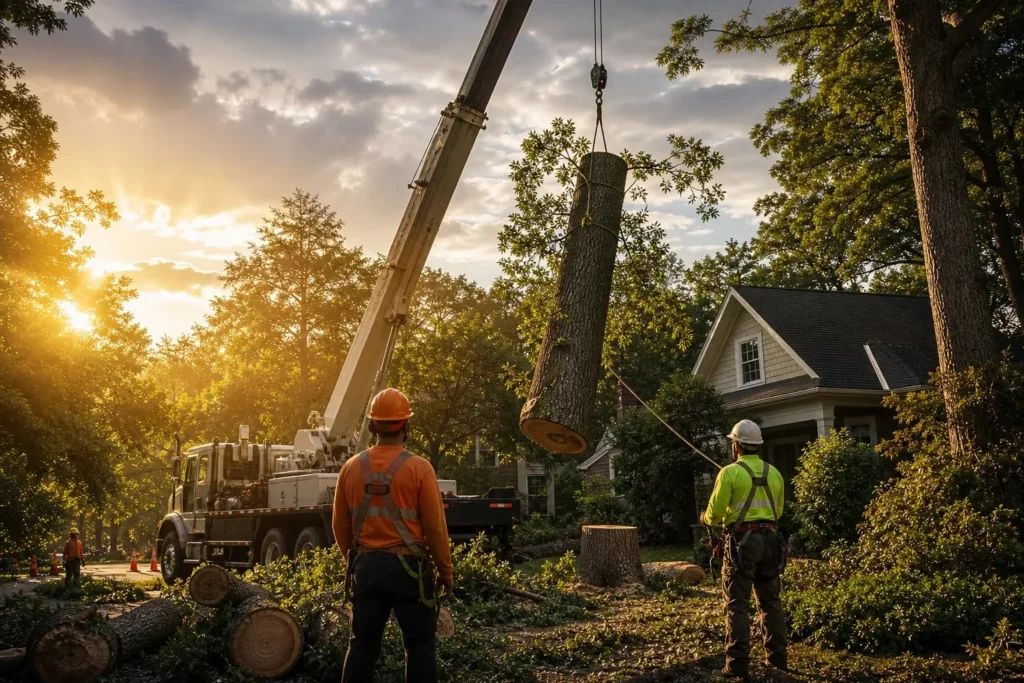
The price to cut down a large tree climbs steeply above 60 feet, and trees in tight spots near structures, power lines, or fencing push toward the upper end of that range fast. Nationally, the typical range for large-tree removal runs $800 to $2,000, while in the Richmond metro, large tree removal commonly runs $800 to $2,400 given local market conditions. Statewide Virginia averages reach $1,575 to $3,675 for this tier. Some complex large-tree jobs, particularly those requiring crane work or specialized rigging, exceed those ranges. If a company quotes you under $800 for a very large tree without any explanation, that’s worth a conversation before you sign anything.
Two trees that look nearly identical can carry quotes hundreds of dollars apart. The size tiers above are useful anchors, but the variables below are what move the number in practice. Every legitimate tree company factors these into their pricing.
A tree standing in the middle of an open backyard is the most straightforward job on any crew’s schedule. A tree leaning toward a roofline, surrounded by a fence, or accessible only through a 36-inch gate is a different story entirely. Restricted access means the crew can’t get equipment into position, which translates to slower work, more manual rigging, and higher labor time. Companies price that additional effort into the quote, and they should. It’s real work.
A healthy, upright tree behaves predictably during removal. A dead, hollow, or severely leaning tree does not. Structural instability means the crew has to work more carefully, use more deliberate rigging techniques, and account for the possibility that the tree could behave unexpectedly during the cut. Dead or diseased trees don’t get a discount; they often cost more because the added risk demands added care. If a company quotes you less for a hazardous tree without explaining why, ask them directly how they’re planning to handle the removal safely.
Some pricing models charge per inch of diameter at breast height (DBH), typically $5 to $10 per inch over 12 inches, though rates vary by provider and region, and separate stump-grinding models often use a different per-inch rate of $2 to $6. Dense hardwoods like oak and hickory take longer to cut through and produce heavier debris than softer species. A thick-trunked oak can genuinely surprise homeowners who only compared tree heights when getting quotes. When you’re describing your tree to any company, mention both the approximate height and the trunk width. It gives them a much more accurate picture before they arrive.
Not every removal can wait for a scheduled appointment, and companies structure their pricing accordingly when urgency is real. Knowing what to expect prevents sticker shock when you’re already dealing with a stressful situation.
A tree actively resting on a structure, blocking a driveway after a storm, splitting from wind damage, or leaning dangerously toward a utility line qualifies as an emergency. So does any situation where a local authority or inspector has flagged the tree as an imminent hazard requiring same-day or next-day response. The defining factor is urgency, not simply the presence of damage. A tree with visible decay that’s been standing for years is a hazard, but it’s not necessarily an emergency in the same way a freshly fallen trunk across your driveway is.
The emergency tree removal price typically runs $1,000 to $2,500 for standard situations. Complex scenarios (a large tree on a roof, for example) can reach $5,000 or more, with the most involved jobs, those requiring extensive crane work or structural shoring, reported at $10,000 in documented cases. Companies generally apply a premium of 25% to 100% above their standard rate, plus a call-out fee in the range of $150 to $350.
Those fees cover after-hours dispatch, rapid equipment mobilization, and the logistical overhead of rearranging a full crew’s schedule on short notice. These premiums are real, but they reflect real risk and real cost. A crew responding to an unstable tree in difficult conditions is taking on liability that a scheduled job simply doesn’t carry.
The base removal quote typically covers cutting the tree down and, in some cases, chipping or stacking debris on-site. What often appears as a separate line item are the services that leave your yard actually usable afterward. Knowing these in advance prevents surprises when the invoice arrives.
Stump removal cost runs $100 to $600 per stump, with most residential stumps in Virginia landing between $150 and $400 for grinding. Full stump extraction, pulling the stump and its major root system out of the ground, costs significantly more, typically $350 to $1,500 depending on size and root spread. For most homeowners, grinding is the right choice. The exception is when you plan to plant a new tree or shrub in the exact same spot; in that case, full extraction makes more sense. DCS Tree Services provides stump grinding as part of our service offering, and we’ll walk you through which option fits your situation during the on-site estimate.
Some companies include debris haul-away in their quote; others charge $50 to $200 extra to load and remove chipped material from the property. Always ask whether the quote assumes the chips stay on-site or get hauled. Leaving wood chips as ground cover or mulch around your remaining trees is a legitimate option that saves money and actually benefits your yard’s soil health over time.
Permit requirements vary significantly by locality. In Richmond, permits for city-owned trees are issued free of charge through the Urban Forestry Division, but private-property requirements depend on the specific situation and local ordinances. Virginia permit fees for private removal are generally modest where they apply, often in the $0 to $250 range for the application itself, based on general national guidance, though fees vary by jurisdiction. Some municipalities charge per-inch recompense fees for removing healthy protected trees, which can add up quickly. Check with your city or county office before the crew starts work; an unpermitted removal can carry fines that dwarf the cost of the permit.
The difference between a fair quote and an inflated one often comes down to how thoroughly the company assessed the job before giving you a number. A quick phone figure based on a description is a rough guess, not a quote.
A reputable company walks your property, examines the tree from multiple angles, asks about site constraints like fence gates and underground utilities, and delivers an itemized written quote that tells you exactly what’s included and what isn’t. They explain their plan for the removal, clarify whether stump grinding and debris haul-away are part of the price, and give you a written figure before any commitment is made. A number scrawled on a business card after a five-minute phone call is not a quote.
Watch for companies that pressure you to sign on the same day, demand full payment upfront, or won’t provide a written scope of work. Those patterns show up consistently in bad experiences, and they’re easy to screen for before you’re committed.
Here’s how we handle it at DCS Tree Services. Every estimate is free, no-obligation, and conducted on-site, and the people who assess your tree are the same crew who will do the work. We walk the property, assess the tree, ask the right questions, and give you a written price before you make any decision. There are no vague line items and no add-ons that appear after we’ve started. If you’re in the Richmond, Virginia area and want a real number you can actually plan around, contact DCS Tree Services to request your free on-site estimate and we’ll schedule a visit at your convenience.
So, how much does tree removal cost? The range isn’t random, and once you understand the drivers, any quote you receive becomes easier to read. In the Richmond area, small trees under 30 feet typically run $225 to $450. Medium trees from 30 to 60 feet land between $450 and $1,200. Large trees above 60 feet start around $800 and can reach $2,400 or more depending on complexity and local site conditions. Emergency situations carry a real premium of 25% to 100% above standard scheduling, plus call-out fees. And services like stump grinding, debris hauling, and permit compliance are often separate line items that the base quote doesn’t always cover.
Knowing these average tree removal rates by size means you can evaluate any bid with clear eyes. You’ll know which line items to ask about, which premiums are justified, and which quotes deserve a follow-up question before you sign. If you’re still unsure what your specific tree will cost to remove, the fastest path to a real number is an on-site look, not a phone estimate. DCS Tree Services serves Richmond-area homeowners with free, no-obligation estimates, and we’ll give you a price you can actually trust.
For a medium tree between 30 and 60 feet, the most common size in suburban Richmond yards, expect to pay $450 to $1,200 nationally, with many local jobs landing in the $450 to $800 range. The final number depends on access, trunk diameter, and whether stump grinding is included.
Usually not. Most base quotes cover cutting the tree down and chipping the debris. Stump grinding is typically a separate line item, running $100 to $600 depending on stump size. Always ask your contractor upfront so there are no surprises on the invoice.
Significantly more. Emergency removal typically runs $1,000 to $2,500 for standard situations, compared to $450 to $1,200 for a scheduled medium-tree removal. The premium reflects after-hours dispatch, rapid mobilization, and the added risk of working on unstable or storm-damaged trees.
For large trees, yes. Richmond-area pricing for trees above 60 feet commonly runs $800 to $2,400, which is in line with or slightly above many national averages. Medium and small tree removal in Richmond tends to track closely with national ranges.